God’s Peace be with you all.
39In those days
Mary set out and went with haste to a Judean town in the
hill country, 40where she entered the
house of Zechariah and greeted Elizabeth. 41When
Elizabeth heard Mary’s greeting, the child leaped in her
womb. And Elizabeth was filled with the Holy Spirit
42and exclaimed with a loud cry, “Blessed
are you among women, and blessed is the fruit of your
womb. 43And why has this happened to
me, that the mother of my Lord comes to me? 44For
as soon as I heard the sound of your greeting, the child
in my womb leaped for joy. 45And blessed is
she who believed that there would be a fulfillment of
what was spoken to her by the Lord.” 46And
Mary said, “My soul magnifies the Lord, 47and
my spirit rejoices in God my Savior, 48for
he has looked with favor on the lowliness of his
servant. Surely, from now on all generations will call
me blessed; 49for the Mighty One has
done great things for me, and holy is his name.
50His mercy is for those who fear him from
generation to generation. 51He has
shown strength with his arm; he has scattered the proud
in the thoughts of their hearts. 52He
has brought down the powerful from their thrones, and
lifted up the lowly; 53he has filled
the hungry with good things, and sent the rich away
empty. 54He has helped his servant
Israel, in remembrance of his mercy, 55according
to the promise he made to our ancestors, to Abraham and
to his descendants forever.” 56And
Mary remained with her about three months and then
returned to her home.
Yesterday at church I mentioned that many Lutheran churches
were having a Marian Service. The
official name of the church holiday is the “Solemnity
of the Assumption of the Blessed Virgin Mary” (the assent of
Mary into heaven) or more commonly known as “Mary, Mother of
our Lord.” This is a church holiday that is set for August
15, which only falls on a Sunday occasionally. I believe
the last time was 2004.
Yesterday, many Catholics celebrated Mary’s
resurrection and ascent into heaven. However, as a
post-reformation protestant congregation, we did not
celebrate this. Had we celebrated Mary at church yesterday,
we still would have not celebrated her resurrection and
ascension. Why not? Because we believe everything about
Mary that is biblical. Therefore this means that we do not
believe the following, which we do not find in the Bible:
1.
In her immaculate
conception, that is, her miraculous birth from a legendary
mother, Anne.
2.
In her assumption,
that is, her bodily ascent into heaven (the only one since
Jesus’ death and resurrection)
3.
In her participation
in the world of salvation, something which the Bible says
nothing about.
As Lutherans, we profess that Mary is the mother
of Jesus, God made man. She was chosen by God, answered the
call of the angel, was obedient, faithful, and was excellent
as a mother. She is therefore a profound witness to God’s
work and a part of the communion of saints. Mary is indeed
someone that we celebrate, but not someone that we worship.
That distinction falls squarely on the shoulders of God. In
his exegetical work for the above text, the Rev. Brian
Stoffregen says the following:
“Why is Mary blessed/praised?
"She is the mother of the Lord." This is what sets Mary
apart from all other believers. At the same time, I'm not
sure how many of us would be praising/blessing a young
teenage, (probably 12-14 years old,) unmarried girl whom we
discover is pregnant. It is likely that these words of
praise come more from the confessions of the early church
than a song from Elizabeth.
"She has come to Elizabeth." Elizabeth's joy at her own
pregnancy after so many years of barrenness is overshadowed
by the joy at Mary's visit -- or rather that the unborn Lord
would honor her with his presence. How wonderful it would be
if we had that same attitude concerning the presence of our
Lord in our gathering together, and in the Word, and in the
Supper: "Blessed be God who has come to us this day." I
think that too often we think of worship as our good deed of
bringing ourselves to God, when, in fact, it is a time and
place where God comes to us.
"She believed that there would be a fulfillment of what
was spoken to her by the Lord." The word for "blessed" in v.
45 is makaria, which carries more the idea of being
happy because of favorable circumstances. A verbal form of
this noun is used in v. 48. As the mother of the Lord, Mary
is unique. As one who believes that God's Word will be
fulfilled, she is a model of faith for us all.”
For those of you that would like more
information on the contrast and comparison of the Catholic
and Protestant beliefs of Mary, feel free to check out the
book “Mary, in the Plan of God and in the Communion
of Saints” by Alain Blancy, Maurice Jourjon, and the
Dombes Group. It has some wonderful information about Mary
and how she fits in with our faith. I have the book if you
want to borrow it.
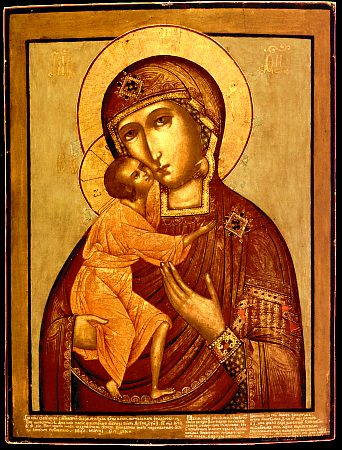
An icon of the Theotokos
(translation: bearer of God, Mother of God):
http://upload.wikimedia.org/wikipedia/commons/a/ac/Fedorovskaya.jpg
In our prayers this week:
Ann, Robert, Charles, and Scott.
God’s Peace,
Pastor Judson